 Jökulsárlón Glacier
Jokulsarlon Ice Cave Tour: Which of the Three, and When
A jokulsarlon ice cave tour costs between $195 and $285, runs from about November to March, and starts at the lagoon car park rather than in Reykjavík. Three of them leave from that car park and they are not the same trip: one keeps the walk short with twelve people, one puts eight people through a 4–6 km trek with an axe and harness, and one drives 4x4 to a cave most groups never reach. What none of them can promise is the cave itself, because the caves melt, flood and collapse on their own schedule.
About the ice cave tours here
Natural caves need cold to be stable. Outside that window the tours here run as glacier hikes
$195 for the twelve-person tour, $275 for the max-8 trek, $285 for the remote 4x4 cave and canyon
The short one is 2 to 4 hours; the remote trip runs a full 6
Meet-on-location. That is 370 km from Reykjavík, about five hours' drive
Ice Walkers Tours caps the remote trip at 8; the car-park tour takes 12
Rent them for about 1,500 ISK if yours are soft-soled. Crampons and helmet are supplied
Check dates
Live calendar for the twelve-person cave tour that meets at the lagoon.
What an Ice Cave Tour at Jökulsárlón Actually Is
Where the caves are
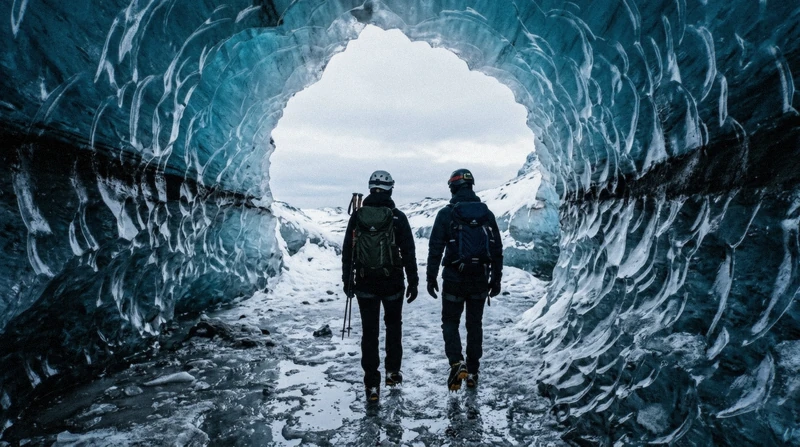
The caves sit inside Breiðamerkurjökull, the outlet glacier that calves into the lagoon. Meltwater carves tunnels through the ice in summer; when the cold returns and the water drains, what is left is a cavity you can walk into. Guides find them fresh each autumn and check them through the winter.
That is why nobody can show you last year's cave. The ice that formed it has moved, and the glacier gives up about 200 m off its front every year. A cave that made the postcards in January 2025 may be a puddle by the following November.
Three tours, three different days
The car-park tour at $195 is the accessible one: a 4x4 from the bus parking area onto the west side of the glacier, a short walk in, twelve people maximum. It suits anyone who wants the cave without the trek, and it holds a 4.8 rating from 202 reviews.
The max-8 trek at $275 is a different proposition: 4–6 km on the ice with crampons, an ice axe and a harness, five to six hours. The remote cave and canyon at $285 uses a 4x4 to reach a part of Breiðamerkurjökull the coaches never see, and reviewers who went specifically mention the absence of other groups.
- $195 · maximum 12 · 2 to 4 hours · shortest walk
- $275 · maximum 8 · 5 to 6 hours · 4–6 km trek with axe and harness
- $285 · 6 hours · 45 minutes of 4x4 each way · cave and ice canyon, no crowds
Who runs them
The remote trip belongs to Ice Walkers Tours, and its published itinerary is plain: 45 minutes of transfer from the lagoon car park, 4.5 hours on Breiðamerkurjökull, 45 minutes back. Across 264 reviews, 98% of English-speaking travellers gave it a perfect score.
The twelve-person tour comes from a small local operator that has been working this side of the glacier for years and describes itself as carbon neutralised. Small matters here: an eight or twelve-person group moves at one pace, and nobody spends the visit waiting for a queue to clear inside a chamber.
How the Day Runs
-
15 min before
Jökulsárlón main car park
Find the marked vehicles by the bus parking area. Guides leave on time and the car park costs ISK 1,000, valid until midnight.
-
00:00
Kit fitting
Crampons, helmet, and a harness on the longer trips. This is where soft trainers get turned away and rental boots come out.
-
00:15
4x4 onto the glacier
Up to 45 minutes on the remote tour, less on the car-park version. The drive across moraine is half the adventure.
-
01:00
On the ice
Crampon technique first, then the walk in. Guides talk through how the cave formed, and stop for photographs where the light works.
-
02:00
Inside the cave
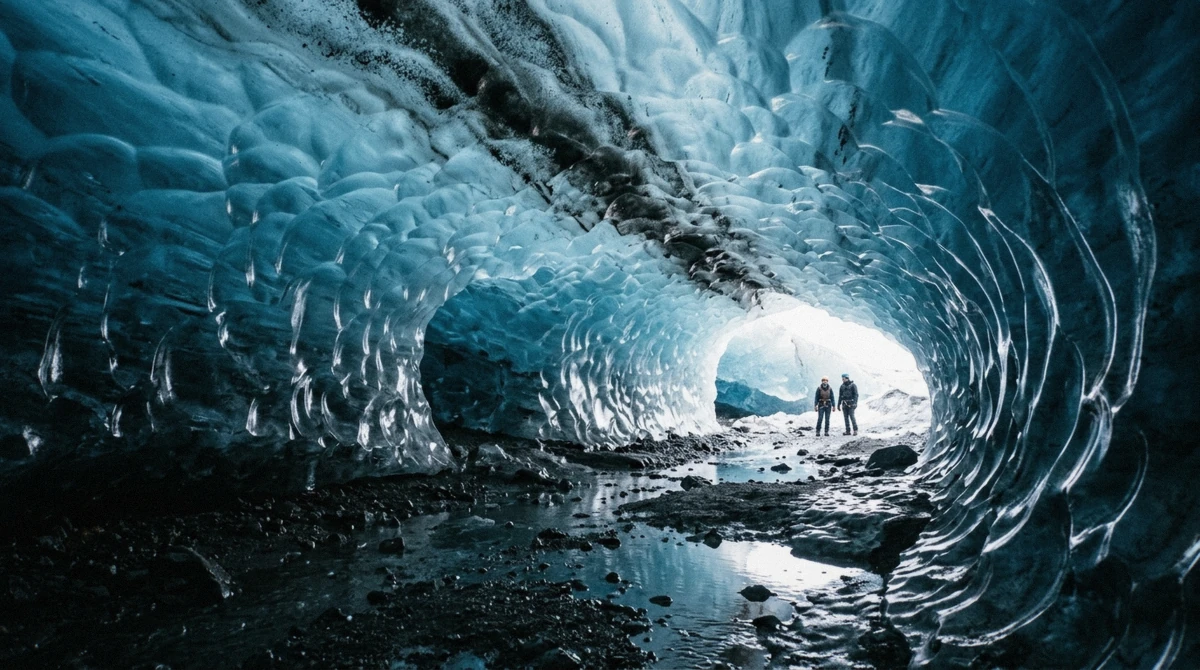
Blue walls, ash bands, and the sound of meltwater somewhere behind the ice. Groups this size get the chamber to themselves.
-
04:00
Back at the lagoon
The short tour finishes here. On the six-hour trips you return closer to dusk in midwinter, which is early: the sun sets before 16:00 in December.
Know Before You Book
When a cave floods, the tour still runs
Ice caves are weather dependent and the operators say so in writing. After heavy rain or a warm spell the chambers flood or turn unstable, and the guide switches to a glacier hike or an ice crevasse instead. You are offered a full refund if that does not suit you.
This happens often enough that you should book expecting it. Reviewers from October and November 2025 describe the swap in detail, and more than one preferred the crevasse to the cave they had paid for. One wrote that a couple on the same walk had done a cave the week before and found the crevasse more dynamic.
- Caves flood after rain or a warm spell, sometimes overnight
- Standard substitute: a glacier hike or an ice crevasse
- Full refund if the alternative does not suit you
- Free cancellation up to 24 hours before, on all three tours
What to wear, and what gets you turned away
Waterproof hiking boots with ankle support are the requirement, not a suggestion. Crampons need a stiff sole to bite, and a guide who sees trainers will hand you rental boots at about 1,500 ISK or refuse the booking.
Everything else is layers: thermal base, warm mid-layer, waterproof shell, hat and gloves. It is cold on the glacier and these tours run in wind and rain, with no refund for arriving unprepared.
- Waterproof boots with ankle support, or rent at about 1,500 ISK
- Waterproof shell and warm layers, every month of the season
- Hat and gloves; the wind off the ice cap does the damage
- A lanyard for your phone, because a dropped one on the ice is gone
Fitness, age and what the walk is really like
Operators ask for moderate fitness, which undersells it on the longer trips. One traveller tracked almost two miles round trip and described the movement as deliberate stomps to make the crampons grip rather than normal walking.
The car-park tour keeps the walk short and works for most people who can manage uneven ground. The max-8 trek does not: that is 4–6 km on ice with a harness, and it is the one to book if you want the day to feel earned.
Getting there, and where to sleep first
Every cave tour on this page meets at the lagoon, 370 km from Reykjavík. Driving down the same morning means leaving before dawn in winter, on a road that closes without much notice.
Sleep on the eastern side of any likely closure. A traveller in February 2026 watched several people miss the same departure because the road out of Vík shut overnight, and Vík is still 190 km short of the lagoon. Options are in where to stay near the lagoon.
How the Caves Form, and Why They Never Repeat
Summer water, winter ceiling
Meltwater runs over and through Breiðamerkurjökull all summer, cutting tunnels the way a river cuts a gorge, except the walls move. When the cold returns the water drains away and the tunnel is left standing, which is the cave a guide walks you into.
That also sets the calendar. Too warm and the chamber fills again; too much rain and the roof loses the strength holding it up. Caves are natural and different every winter, and the ice that forms one this year has usually moved or collapsed by the next.
Why the blue is real
Glacier ice under pressure squeezes out its air bubbles. What is left absorbs the red end of the spectrum and throws back blue, so the denser and older the ice, the deeper the colour. A wall that looks like backlit glass is ice that spent centuries under a few hundred metres of weight.
White ice is younger, full of air, and sits nearer the surface. The dark bands running through both are volcanic ash, each one an eruption the glacier caught and buried decades ago.
Natural caves, man-made tunnels and the summer options
Everything at Jökulsárlón is natural, which is why it is seasonal. Two products advertised in Iceland are not: the ice tunnel inside Langjökull was cut by machine and runs all year, and Katla's cave under Mýrdalsjökull is dark, ash-heavy and open in summer.
If you are here in July and set on going inside ice, those are the honest alternatives. They are also three to five hours' drive west of this car park, so they are a different day, not a substitute.
- Jökulsárlón and Breiðamerkurjökull: natural, blue, November to March
- Katla under Mýrdalsjökull: natural, ash-dark, runs in summer, 190 km west
- Langjökull ice tunnel: man-made, all year, near the Golden Circle
Photographing a cave without ruining the visit
Light comes from the entrance and from thin patches of roof, so exposures are long and the group moves. A wide lens, a high ISO and bracing against a wall gets more usable frames than a tripod that holds everyone up.
Guides stop for photographs at the good chambers, and the eight and twelve-person groups exist precisely so nobody is queuing behind you. Lens cloth in a pocket: the cave drips constantly.
Where the Tours Meet
The main car park at Jökulsárlón, next to the café and the bus parking area. Both cave operators marshal here.
Booking Windows and What a Cave Day Costs
When these sell out
December and January are the pinch: the caves are at their best and the working day is short, so operators run fewer departures. The eight-person trips go first, and travellers book the 4–6 km trek an average of 54 days ahead.
November, February and March are calmer. Outside a holiday week you can often book two or three days out, and the weather matters more than the calendar.
The real cost of the day
The tour is the biggest number but not the only one. Add the car park, boots if you did not bring any, and fuel from wherever you slept, because there is no petrol at the lagoon.
The last pumps are at Freysnes, 55 km west, and in Höfn, 80 km east. Neither is somewhere to discover you are running low in a February dusk.
| Item | Cost | Note |
|---|---|---|
| Cave tour | $195 to $285 | Depending on group size and length |
| Car park | ISK 1,000 | Valid until midnight, covers the whole day |
| Boot rental | about 1,500 ISK | Only if yours have soft soles |
| Food | Bring it | The café is at the lagoon, nothing on the glacier |
| Fuel | Freysnes or Höfn | 55 km west or 80 km east, no pumps at the lagoon |
Ice Cave Tour Questions
When can you visit the ice caves at Jökulsárlón?
Natural caves are stable from about November to March. Outside that window the same operators run glacier hikes instead, and the summer ice caves you see advertised in Iceland are elsewhere, at Katla or inside Langjökull, on different tours entirely.
How much does a Jökulsárlón ice cave tour cost?
From $195 for the twelve-person tour that meets at the car park, $275 for the max-8 trek, and $285 for the remote 4x4 cave and ice canyon. None of them include the ISK 1,000 car park or boot rental at about 1,500 ISK.
Are the ice caves safe?
With a guide, yes, and that is the reason guiding is compulsory. Guides check the chambers through the season and pull the tour when a roof looks wrong. Every group gets a helmet and crampons, and the operators cancel rather than push a doubtful cave, which is why substitutions are so common.
What happens if the cave is closed?
The guide offers an alternative, normally a glacier hike or a walk into an ice crevasse, or a full refund if you would rather not. Reviewers who got the crevasse in autumn 2025 rated it as highly as the cave, so it is not a consolation prize.
Do I need hiking boots?
Yes, waterproof and with ankle support, because crampons will not hold on a soft sole. Operators rent boots for about 1,500 ISK a pair. Trainers are refused at the meeting point and no refund is given for turning up in them.
Can children go into the ice caves?
Most operators set a floor of about eight to ten years and expect moderate fitness, since the ground is uneven and the walk in can be long. The car-park tour is the one that works for families; the 4–6 km trek is not.
How is this different from a glacier hike?
A glacier hike walks the surface all year. A cave tour goes inside, and only in winter. Both use crampons and both start at the same car park, so the real choice is the season you are visiting in. There is more on the surface option in the glacier hike guide.
What Travellers Said
Three stunning ice caves and worth the hike. We were fortunate enough to explore three beautiful caves, each unique in its own way.
Excellent communication from the guide Martin. Great remote place away from crowds and unique experience.
Couldn't go into the normal ice caves due to warm temperatures, but the alternative hike on top of the glacier and down into crevices in the ice was still a great and fun experience.
We were a small group of 6 and we had Marcin as guide. All these experience promises, it delivers.